

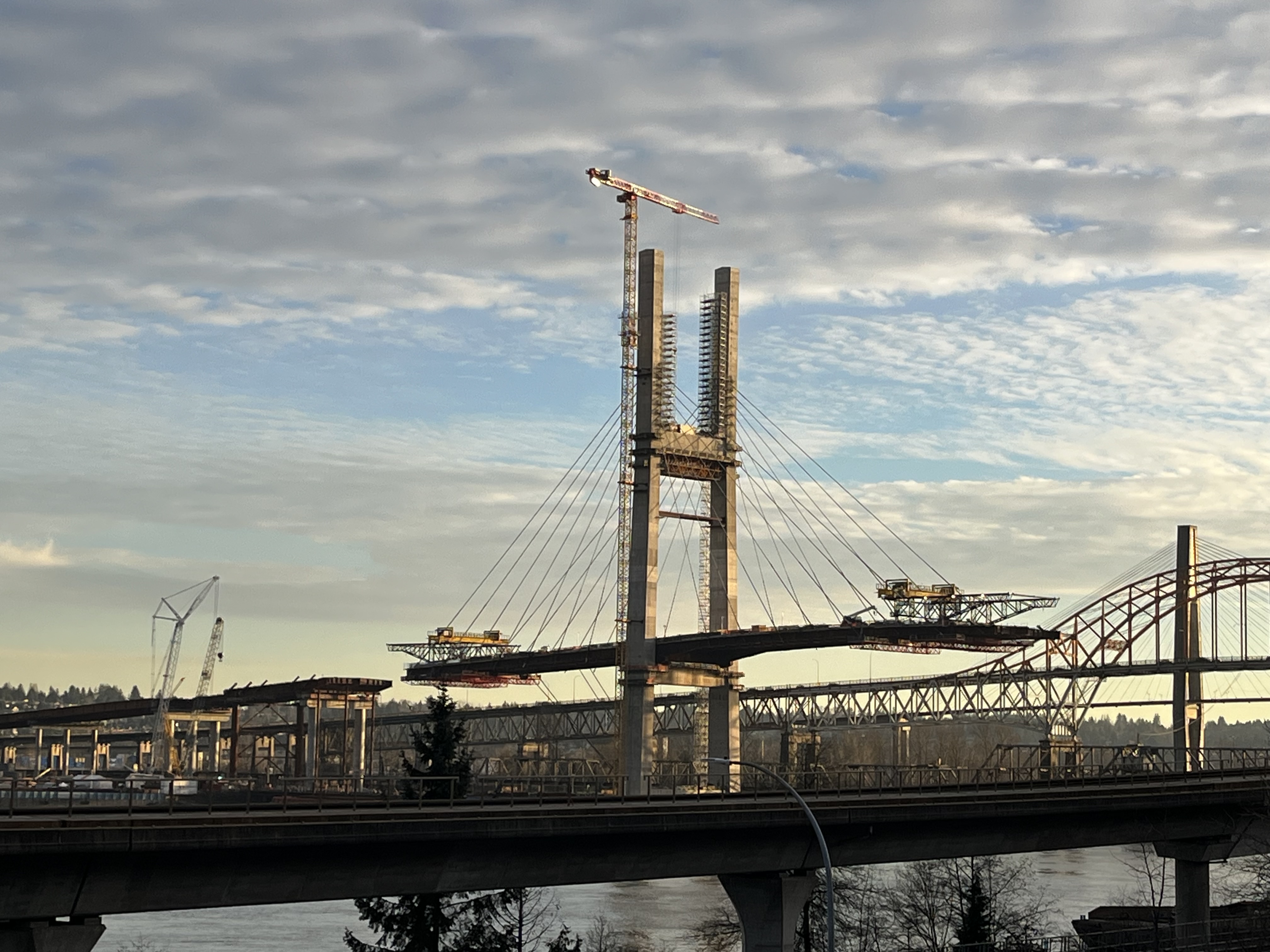
The stal̕əw̓asəm (Riverview) Bridge, formerly known as the Pattullo Bridge, functions as a key connector between the cities of Surrey and New Westminster in British Columbia's Lower Mainland. Thurber acted as the Durability Engineer of Record for this project.
The original Pattullo Bridge was built in 1936 and having reached the end of its service life and no longer supporting the travel needs of community, the Pattullo Bridge Replacement project was born. The new structure consists of a 1,235-meter-long bridge with a 332-meter-long cable supported main span and two approach structures (North and South) on each side. The main tower has a height of around 170 meters, making the new structure the tallest bridge in British Columbia. It also has a design service life of 100 years, which is significantly more than the typical service life of a new bridge structure. This required the use of higher quality construction materials (such as stainless-steel reinforcement and low permeability concrete), as well as the implementation of innovative construction techniques and quality assurance methods.
Over the project's lifespan, our services have included:
- Project Durability Plan Development
- Reinforced Concrete Durability Analysis
- Steel Corrosion Analysis and Protective Coatings Design
- Deep Foundation Integrity Testing Review
- Mass Concrete Thermal Control Planning, including finite element thermal modeling
- Engineering support related to complex reinforced concrete repairs
The flowing Fraser River surrounding the new bridge's foundations added new complexity to the project.
Mass concrete deep foundations that are located under the main tower are exposed to the constant flow of the river, resulting in a more aggressive convective heat loss from the surface of the elements during the mass concrete thermal control period. During this time when freshly-placed concrete is getting extremely hot due to exothermic cement hydration, engineers work to restrict the temperature differential between the thermal core and surface of the concrete. However, with the aggressive convective heat loss caused by the cold water, models showed that there was an excessive thermal differential within the element which could result in thermal cracking.
To mitigate the risk of thermal cracking, Thurber's team assisted with the design of an active-cooling system that removed heat from the core of the deep foundation element using the very thing that could cause thermal cracking - the river water. Water was circulated through pre-installed thin-walled pipes within the structure, reducing the thermal differential within the mass concrete. This was the first documented use of active cooling system for submerged and non insulated piles in Canadian history.
The stal̕əw̓asəm Bridge now connects tens of thousands of British Columbians each day and connected Thurber's engineers from across the country.
While based out of our Vancouver branch, Material Engineers from our Victoria, Calgary, and Edmonton branches played key roles in the delivery of this project.